(Complexity, Contradiction, Controversy, and Cost)
Chuyển đổi bền vững, tức sự chuyển dịch hệ thống hướng tới các thực hành hài hòa giữa môi trường, xã hội và kinh tế, là điều kiện cần để ứng phó với các thách thức toàn cầu như biến đổi khí hậu, cạn kiệt tài nguyên và bất bình đẳng. Tuy nhiên, quá trình này không tuyến tính mà bị chi phối bởi một tập hợp rào cản cấu trúc, có thể khái quát thành “thách thức 4C”: Phức hợp, Mâu thuẫn, Tranh Cãi và Chi Phí.
Phức hợp / Complexity
Tính phức hợp của chuyển đổi bền vững nằm ở bản chất liên ngành và liên hệ thống của nó. Các hệ thống kinh tế, xã hội, môi trường và công nghệ không vận hành độc lập mà đan xen, tạo ra những vòng phản hồi khó dự đoán.
Khung “Kinh tế Bánh Vòng” nhấn mạnh yêu cầu đồng thời duy trì trong giới hạn sinh thái và đáp ứng nhu cầu xã hội, từ đó làm rõ tính đa chiều và liên kết của quá trình chuyển đổi (Raworth 2017). Ở góc độ kinh tế học sinh thái, Daly chỉ ra rằng việc dung hòa tăng trưởng với giới hạn sinh học làm gia tăng độ phức tạp của hoạch định chính sách (Daly 1996).
Trong thực tiễn, việc điều chỉnh chuỗi giá trị toàn cầu theo hướng bền vững đòi hỏi tích hợp các nguồn tri thức phân mảnh và điều phối nhiều chủ thể với lợi ích khác nhau; đây là một thách thức mang tính hệ thống hơn là kỹ thuật đơn thuần (Berthet et al. 2024). Hệ quả là các sáng kiến bền vững thường bị chậm trễ hoặc triển khai không đồng đều.
Mâu thuẫn/ Contradictory
Chuyển đổi bền vững không chỉ phức tạp mà còn mang tính mâu thuẫn hay xung đột nội tại. Các mục tiêu kinh tế ngắn hạn thường xung đột với các mục tiêu môi trường và xã hội dài hạn. Đầu tư ESG như một sản phẩm (quan điểm ngắn hạn); hội nhập ESG như một quá trình và tiến bộ (quan điểm dài hạn).
Mô hình “ba trụ cột” (3P-People, Planet and Profit) cho thấy rõ sự căng thẳng giữa lợi nhuận, con người và hành tinh (Elkington 1997). Trong khi đó, Daly lập luận rằng logic tăng trưởng truyền thống vốn đã mâu thuẫn với giới hạn sinh thái (Daly 1996).
Ở cấp độ thực tiễn, các công nghệ mới có thể đồng thời tạo ra hiệu quả và rủi ro. Ví dụ, Công nghiệp 4.0 giúp tăng năng suất nhưng cũng có thể làm gia tăng tiêu thụ tài nguyên và áp lực môi trường. Ngoài ra, các phê bình chính sách từ Lomborg cho thấy một số can thiệp khí hậu có thể tạo ra “mâu thuẫn chính sách”, khi nguồn lực bị phân bổ kém hiệu quả (Lomborg 2020).
Những mâu thuẫn này khiến việc ra quyết định không còn là tối ưu hóa, mà là quản trị đánh đổi.
Tranh Cãi / Controversy
Tranh cãi là đặc trưng không thể tách rời của chuyển đổi bền vững, phản ánh sự khác biệt về giá trị, lợi ích và nhận thức.
“ESG đang thất bại trong việc thúc đẩy phát triển bền vững”. Theo Marcos Athias Neto, Trợ lý Tổng thư ký Liên hợp quốc kiêm Giám đốc Văn phòng Hỗ trợ Chính sách và Chương trình của UNDP (Neto 2021). Ở cấp độ toàn cầu, các nỗ lực hợp tác thường bị chi phối bởi cạnh tranh địa chính trị và lợi ích quốc gia, làm suy giảm khả năng đạt đồng thuận (Sachs 2015). Ở cấp độ tri thức, tranh cãi cũng xuất hiện giữa các hệ hình khác nhau, chẳng hạn giữa cách tiếp cận khoa học phương Tây và tri thức bản địa (Kimmerer 2013).
Trong lĩnh vực chính sách khí hậu, các quan điểm đối lập về mức độ khẩn cấp và hiệu quả của giải pháp tiếp tục tạo ra tranh luận. Lomborg, chẳng hạn, cho rằng nhiều chính sách khí hậu hiện tại có chi phí cao nhưng hiệu quả hạn chế, một lập luận gây tranh cãi mạnh trong giới học thuật và chính sách (Lomborg 2020).
Bên cạnh đó, các công nghệ mới như tự động hóa hay dữ liệu lớn cũng đặt ra vấn đề về quyền riêng tư, việc làm và niềm tin xã hội, từ đó làm gia tăng tranh cãi trong triển khai. Những bất đồng này thường làm chậm tiến trình chuyển đổi.
Chi Phí / Cost (LY)
Chi phí là rào cản hữu hình nhất của chuyển đổi bền vững. Việc tái cấu trúc hệ thống sản xuất, đầu tư công nghệ sạch và xây dựng hạ tầng mới đòi hỏi nguồn lực tài chính lớn.
Hawken nhấn mạnh rằng chuyển đổi sang nền kinh tế tái tạo cần đầu tư đáng kể, trong khi lợi ích thường chỉ xuất hiện trong dài hạn (Hawken 1993). Raworth cũng thừa nhận rằng việc tái thiết hệ thống kinh tế theo hướng bền vững đòi hỏi chi phí chuyển đổi không nhỏ (Raworth 2017).
Đối với các doanh nghiệp nhỏ và các nền kinh tế đang phát triển, hạn chế về vốn khiến việc áp dụng các giải pháp bền vững trở nên khó khăn hơn. Đồng thời, khi chi phí môi trường chưa được nội hóa đầy đủ, các tổ chức tiên phong thường phải chịu bất lợi cạnh tranh (Daly 1996).
Ở cấp độ chính sách, tranh luận về chi phí cơ hội cũng rất rõ rệt; một số quan điểm cho rằng nguồn lực dành cho giảm phát thải có thể được sử dụng hiệu quả hơn cho đổi mới công nghệ dài hạn (Lomborg 2020).
Những rào cản tài chính này khiến chuyển đổi bền vững không chỉ là vấn đề ý chí, mà còn là vấn đề năng lực.
Kết Luận / Conclusion
Bốn thách thức Phức Hợp, Mâu Thuẫn, Tranh Cãi và Chi Phí tạo thành một khung phân tích hữu ích để hiểu bản chất của chuyển đổi bền vững. Đây không phải là một quá trình tuyến tính hay thuần kỹ thuật, mà là một quá trình mang tính hệ thống, chính trị và kinh tế sâu sắc.
Việc nhận diện rõ các thách thức này giúp chuyển trọng tâm từ “triển khai giải pháp” sang “quản trị chuyển đổi”; từ tối ưu hóa cục bộ sang điều phối hệ thống; từ đồng thuận giả định sang quản trị bất đồng.
Do đó, chuyển đổi bền vững chỉ có thể tiến triển khi các chiến lược được thiết kế theo hướng thích ứng, đa bên và chấp nhận đánh đổi, thay vì tìm kiếm các giải pháp thường bị đơn giản hóa cho những nan đề phức hợp.
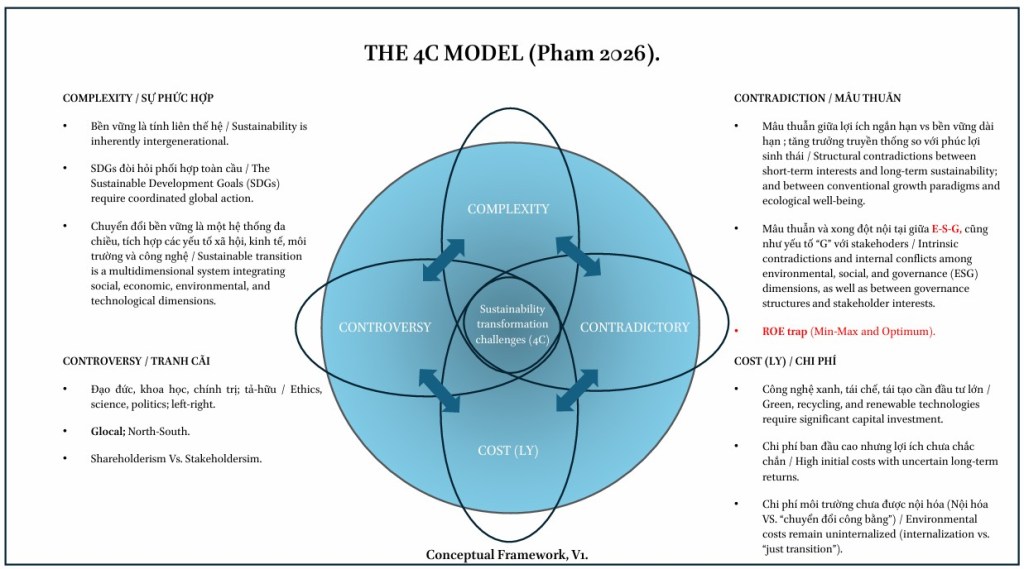
The 4C Challenges of Sustainable Transition: Complexity, Contradictory, Controversy, and Cost
Sustainable transition, understood as a systemic shift toward practices that balance environmental, social, and economic dimensions, is a necessary condition for addressing global challenges such as climate change, resource depletion, and social inequality. However, this process is not linear; rather, it is shaped by a set of structural constraints that can be conceptualized as the “4C challenges”: Complexity, Contradictory, Controversy, and Cost.
Complexity
The complexity of sustainable transition lies in its interdisciplinary and systemic nature. Economic, social, environmental, and technological systems do not operate independently but are intertwined, creating feedback loops that are difficult to predict.
The Doughnut Economics framework emphasizes the need to operate within ecological limits while simultaneously meeting social needs, thereby highlighting the multidimensional and interconnected nature of the transition (Raworth 2017). From an ecological economics perspective, Daly argues that reconciling economic growth with biophysical limits increases the complexity of policy design (Daly 1996).
In practice, aligning global value chains with sustainability goals requires integrating fragmented knowledge systems and coordinating multiple actors with diverse interests; this represents a systemic rather than purely technical challenge (Berthet et al. 2024). As a result, sustainability initiatives are often delayed or unevenly implemented.
Contradictory
Sustainable transition is not only complex but also inherently contradictory, involving internal tensions and conflicts. Short-term economic objectives often conflict with long-term environmental and social goals. ESG investment may be approached as a product (a short-term perspective), while ESG integration represents a process of transformation and progress (a long-term perspective).
The “triple bottom line” model (People, Planet, Profit) clearly illustrates the tensions between profit, society, and the environment (Elkington 1997). Meanwhile, Daly argues that conventional growth logic is fundamentally at odds with ecological limits (Daly 1996).
At the practical level, new technologies can simultaneously generate efficiency and risk. For example, Industry 4.0 enhances productivity but may also increase resource consumption and environmental pressure. In addition, policy critiques suggest that some climate interventions may create “policy contradictions,” where resources are allocated inefficiently (Lomborg 2020).
These contradictions imply that decision-making in sustainability is no longer about optimization, but about managing trade-offs.
Controversy
Controversy is an inherent feature of sustainable transition, reflecting differences in values, interests, and perceptions.
“ESG is failing to advance sustainable development,” according to Marcos Athias Neto, Assistant Secretary-General of the United Nations and Director of the UNDP Bureau for Policy and Programme Support (Neto 2021). At the global level, cooperation efforts are often shaped by geopolitical competition and national interests, reducing the likelihood of consensus (Sachs 2015). At the epistemic level, controversies also arise between different knowledge systems, such as Western scientific approaches and Indigenous knowledge (Kimmerer 2013).
In climate policy, divergent views on both urgency and effectiveness continue to fuel debate. Lomborg, for instance, argues that many current climate policies are costly yet inefficient, a position that remains highly controversial in both academic and policy circles (Lomborg 2020).
Moreover, emerging technologies such as automation and big data raise concerns about privacy, employment, and social trust, further intensifying controversy in implementation. These disagreements often slow the pace of transition.
Cost (LY)
Cost is the most tangible barrier to sustainable transition. Restructuring production systems, investing in clean technologies, and building new infrastructure require substantial financial resources.
Hawken emphasizes that transitioning to a regenerative economy requires significant investment, while the benefits often materialize only in the long term (Hawken 1993). Raworth similarly acknowledges the considerable transition costs associated with restructuring economic systems (Raworth 2017).
For small and medium-sized enterprises and developing economies, limited financial capacity makes the adoption of sustainable solutions more difficult. At the same time, when environmental costs are not fully internalized, early adopters often face competitive disadvantages (Daly 1996).
At the policy level, debates over opportunity costs are also prominent; some argue that resources allocated to emissions reduction could be more effectively used for long-term technological innovation (Lomborg 2020).
These financial barriers indicate that sustainable transition is not merely a matter of intention, but fundamentally a matter of capacity.
Conclusion
The four challenges—Complexity, Contradictory, Controversy, and Cost—form a useful analytical framework for understanding the nature of sustainable transition. This is not a linear or purely technical process, but a deeply systemic, political, and economic transformation.
Recognizing these challenges shifts the focus from “solution implementation” to “transition governance”; from local optimization to systemic coordination; and from assumed consensus to the management of disagreement.
Sustainable transition can therefore only progress when strategies are designed to be adaptive, multi-stakeholder, and capable of managing trade-offs, rather than relying on often simplified solutions to inherently complex problems.
References / Danh mục tham khảo
Berthet, Elsa, et al. 2024. “Navigating the Complexity: The Sustainability Challenges in Global Value Chains.” Annual Review of Resource Economics 16: 349–77. https://www.annualreviews.org/content/journals/10.1146/annurev-resource-101623-102101
Daly, Herman E. 1996. Beyond Growth: The Economics of Sustainable Development. Boston: Beacon Press.
Elkington, John. 1997. Cannibals with Forks: The Triple Bottom Line of 21st Century Business. Oxford: Capstone.
Hawken, Paul. 1993. The Ecology of Commerce. New York: HarperBusiness.
Kimmerer, Robin Wall. 2013. Braiding Sweetgrass. Minneapolis: Milkweed Editions.
Lomborg, Bjørn. 2020. False Alarm. New York: Basic Books.
Marcos Athias Neto. 2021. “Why ESG Is Failing Sustainable Development.” United Nations Development Programme. https://sdgfinance.undp.org/news-events/why-esg-failing-sustainable-development.
Raworth, Kate. 2017. Doughnut Economics. White River Junction: Chelsea Green.
Sachs, Jeffrey D. 2015. The Age of Sustainable Development. New York: Columbia University Press.
 econowhere